

Personal Signal
March 9, 2026
Charleston Race Week
March 9, 2026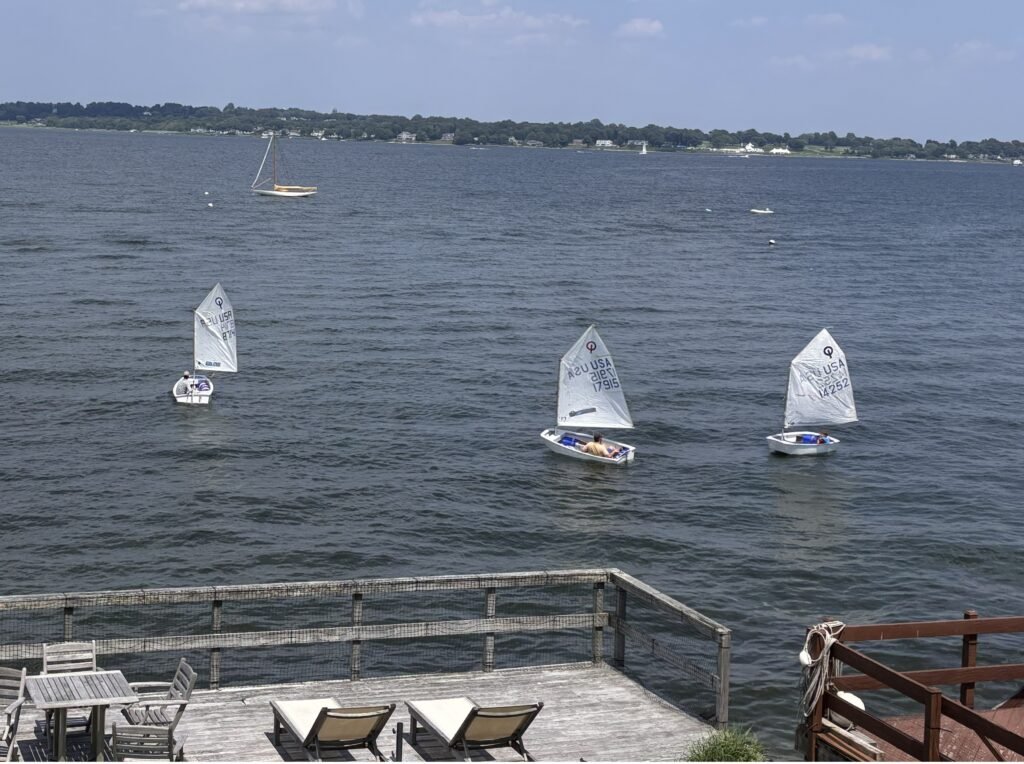
Larry and I were lucky to have our children sail with us. Paul Jr. went through the entire junior program at our yacht club, so he had plenty of sailing friends to recruit when we sailed Jazz Fish. As they were aging out and moving away, Larry’s daughter Alejandra joined the sailing team at Boston University and brought along her friends to sail with us. Then, one day they were all gone, married, moved away and establishing their careers from the East to West coast. Such is the problem with sailing big boats, eventually you have to start recruiting again, or, as in our case, switch to a smaller boat.
Which brings us to the next generation. I have three grandchildren in South Carolina and two in California. Both families take summer vacations at our home on Narragansett Bay, so it was only natural that we should set up the Ponyo Sailing School to get them on the water.
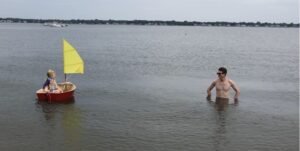
We started the school when the oldest was about four years old. Joanne and I built a lovely Bumblebee dinghy from a design by Angus Rowboats. It was four feet long and had a small sail, though you could use the boat without it. The design called for a battery-operated bilge pump mounted underwater on the rudder, mounted front to back. When switched on, it pumped sea water in at the front and discharged it out the back, like a little jet engine. It pushed the boat along at about one mph. That was enough speed to give the child steerage, yet slow enough for a parent to walk along next to the boat.
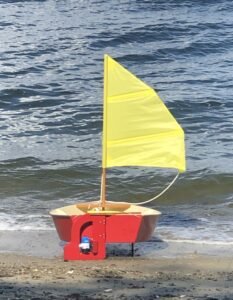
We detail the building of the Bumblebee in Chapter 10 (Taking a break to build Norah’s boat. ) of the book you’ll find on this site:
One nice thing about having the motor on the rudder is that the child learns intuitively how to steer a boat. Because it is jetting along, the boat responds to every tiller movement. At first, they enjoyed making the boat go around in circles, but in a little while one learned how to go straight and then so did the others. Children like to learn by copying each other. There was no need for us to drone on about, “Move the tiller in the direction you don’t want to go!”
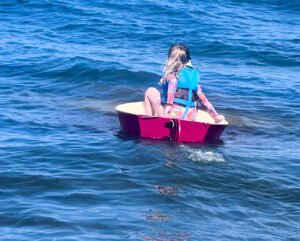
Jetting along
The oldest, Norah, took to it right away, but she had four younger siblings and cousins who were nervous, so for them we just left the boat out on the lawn, like any other toy. Charlie and Ella would periodically climb into the boat, crawl all over the seats, and tug on the tiller. After they were comfortable playing in the boat, we took it to the water and one by one they learned how to control it and took off on their own. One of them went on small adventures when she was only two years old.
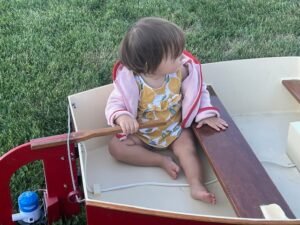
Penny playing in the boat. She’s showing promise!
We also took them out on a Beetle Catboat and gave them turns steering it. Henry took to this boat very quickly.

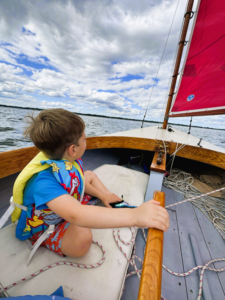
Henry liked the Beetle best
As they reached five to eight years old I thought it was time to introduce them to their own boats, which meant I need a fleet of Optimist dinghies. I found three old, beat-up Optis at the Severin Sailing Program in Annapolis. Joanne and I took a drive to purchase them and saw that “beat-up” was an understatement. I enjoyed seeing that the boats were banged up, cracked, or split. This would be a fun winter project.
I began by sanding down all the prior repairs to discover and document prior damage. Then I went to work on the big challenge, the bows. The repairs required reattaching where it was split, filling holes, and reglassing the entire joint.
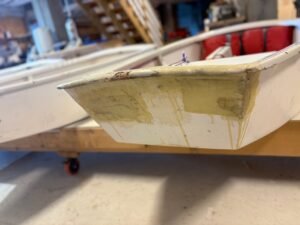
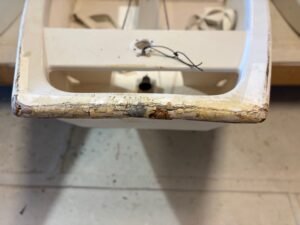
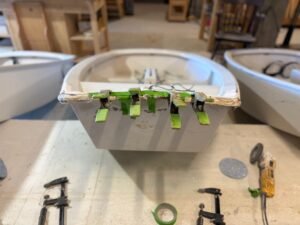
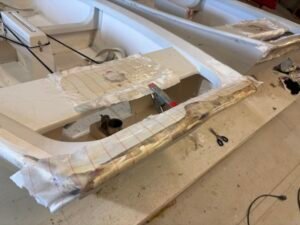
There were holes on the sides, split gunwales and cracked mast thwarts, and a whole bunch of cosmetic problems. When I finished big repairs a few coats of polyurethane paint brought back the shine.
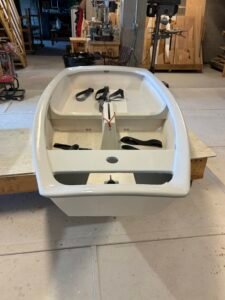
The girls decided the Optis should be named Snap, Crackle and Pop, and so they were.
Next, we turned our attention to the accessories. The sails had been held together with packing and masking tape. These were replaced with sail repair tape. New flotation bags were purchased, some lines were replaced, and a rack was built by the water to store them.
The PONYO Sailing School was open.
Aaron, Paul and I explained a few basics about sailing on the lawn and jiggled the boats around to simulate tacking. Then we launched them and set the kids loose to play on the water.
-
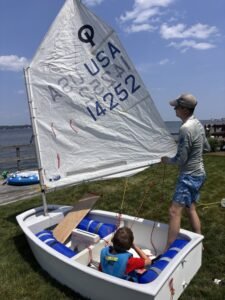
- A few lessons on shore…
-
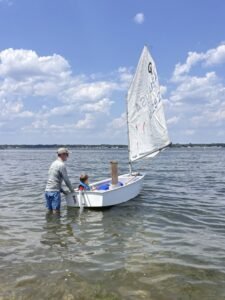
- …and away they go
-
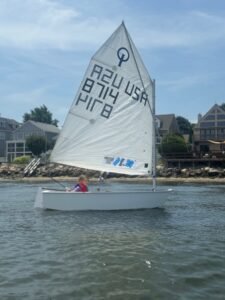
- They learned to keep wind in their sails
-
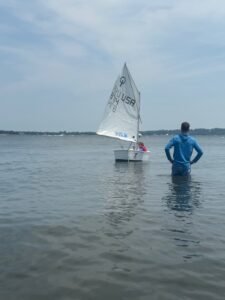
- At first someone stayed close to them…
-
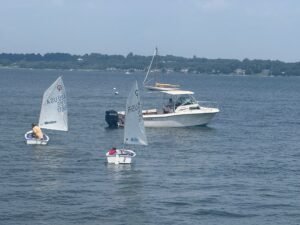
- …but after a short while we could let them go and explore. Paul is in the boat on the left showing what to do without saying anything. The kids could learn by copying him.
At first, we stayed near them. Sometimes we used a dinghy and other times a parent in another Opti sailing near them.
Within a few days they were off on their own. We watched from a distance while we gave them their own space to explore. I gave them targets they could get to on a beam reach. I figured there was no need to spoil their fun with upwind work. They were young enough that when they needed to go in that direction, they would just figure it out on their own, and a few of them did.
The theme was playing on the water, and Norah found the most fun was hiking out like mad while her father tried to capsize her. That got her used to the hiking straps while the boat was tilted, and then to plunging underwater when he flipped her. She also felt a sense of satisfaction when she climbed up on the centerboard and righted the boat again. That’ll show him. One day this went on for almost an hour.
We are entertaining one request for next summer, a waterproof Bluetooth speaker so they can listen to the Moana soundtrack while they cruise the anchorage.
PONYO Sailing School – Unstructured fun on the water and playing in boats. Just the way I learned almost 70 years ago.
Here’s a little video of how our first day want.